Showing posts with label fantasy. Show all posts

Wednesday, June 17, 2009

The Magician's Nephew

The Magician's Nephew
by C.S. Lewis
Fantasy
Harper Collins, 1955

Summary: Digory Kirke and Polly Plummer become friends in London in 1900 after Digory and his dying mother come to live with Digory’s aunt and uncle. While exploring in the attic of the row houses in which they live, the children enter the uncle’s study. He tricks the children into using magic rings he has made to travel to other worlds; the children accidentally bring back an evil queen. In attempting to return the queen to her own world, the children enter the land of Narnia and witness its birth, brought about by Aslan, a symbolic lion. By completing a mission of atonement, Digory earns the right to a magical apple that cures his mother. They have, however, brought the evil queen to the land of Narnia, where she will later cause many problems. Aslan returns the children to London, Digory’s life improves, and Digory and Polly live the remainder of their lives as good friends. Digory changes during the book from an impulsive boy who is unable to avoid temptation to one who can analyze the results of temptation and who then does what is right.

This book of fantasy is the first that should be read in the series of seven books in the Narnia Chronicles that were written by Lewis in the late ‘40s through mid-‘50s. The books are full of fantasy and religious symbolism, pitting good against evil. The books are short, simply written, and would be enjoyed by adolescents who enjoy fantasy and are not put off by the old-fashioned descriptions and words used in the book—it was, after all, set in 1900 London. The books can also be read and enjoyed by adults who enjoy interpreting the religious symbolism. C.S. Lewis was a prominent Christian apologist in his time, and his books, including The Screwtape Letters, are among my favorites.

Themes: Dealing with loss of parents, dependency on others, loss of familiar life, friendship, adventure and exploration, temptation, courage, faith, loyalty, belief in oneself, doing the “right thing,” and being able to tell good from evil.

Rationale for Use: Entertaining, with characters that are very likable. The situation the young boy finds himself in, living with relatives and with a dying mother, is still relevant today. Complex in the underlying theme of religious symbolism.

Content Area Connections: This book could be used in a religion class or in an English class. In both situations, the symbolism could be explored and class discussions could be held to determine how students interpret the author’s characters, especially Aslan.

Possible Problems or Concerns: Some students may view the book as too old fashioned to read, and fantasy is difficult for some to embrace. Others, who see the religious symbolism, may object to Lewis’ strong Christian values and creationist views.

~Arnelle Ambrose

Witches

Witches
by Roald Dahl
Fiction
Puffin Books, 1983


Summary: A young man, during a family visit to his grandmother’s in Norway, is orphaned after an automobile accident takes the life of both parents. Grandmother, a self-acclaimed expert on witches, tells many tales to her grandson about how witches love to destroy children. While on holiday, the pair find themselves at a hotel in the company of all the witches in England, and the Grand High Witch herself. After being discovered listening to a plan to destroy the children of England, the young man is captured and turned into a mouse. He manages to escape to his grandmother and the two of them devise a plan to destroy the witches with their own magic. Even though his plan is successful, he still must live his life as a mouse; albeit, one with human voice and thoughts. The boy learns to accept what he has become, as does grandmother, and to use his mouse body to his advantage to destroy even more witches. This book is easily read in 2 – 3 hours and has many drawings to depict the story. Dahl has written several books for young people, the most famous is likely Charlie and The Chocolate Factory.

Themes: Overcoming adversity, survival in tough times.

Rationale for Use: An easy and fast read, simple story line with interesting characters and detailed illustrations.

Possible Problems or Concerns: The idea of both parents dying may be disturbing. Witches and spells may frighten younger readers or offend their family. Many terms and phrases are more common in England and American students may not be familiar with them.


~Jim Staten

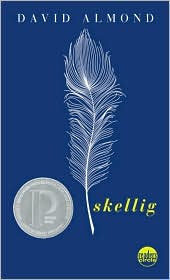
Skellig

Skellig
by David Almond
Fantasy
Random House, 1998

Summary: Michael has just moved with his family into a “fixer-upper” across town. His baby sister, who was born prematurely, has to make many trips in and out of the hospital for life threatening illnesses, often leaving Michael at home with just Dad. As Dad begins renovations on the house, Michael is left to explore the yard and the nearly dilapidated old garage. As his curiosity gets the best of him, Michael discovers a “sickly being” of sorts in the garage which seems to have features of a human, an angel, and a bird. Michael and his new friend next door, Mina secretly nurse the being back to health. As his baby sister’s health is in danger throughout the story, Michael’s friendships with Mina and this mystical creature, teach him many valuable lessons about life, death, trust, and love. In the end, the creature he now called Skellig is connected to Michael’s feeble baby sister. To find out how, read Skellig by David Almond.

Themes: Life and death, friendship, family, home school, birds of prey and their life cycles, mystical beings, and emotional issues including worrying and dependence on others in times of need.

Rationale for use: Real life situations, mysterious places to explore, mysterious beings, and believable characters

Content Area Connections: Relationships with family and friends, life cycles of birds especially owls, compare/contrast skill with home school versus public school, the human body and its systems, and a study of ancient birds such as the archaeopteryx.

Possible Problems or Concerns:

  • The life and death battle with the baby sister and the mystical creature might be upsetting.
  • Although this book is on approximately the 4-5 grade level, many abstract connections might not be made without teacher prompting.
~Marsha Johnson